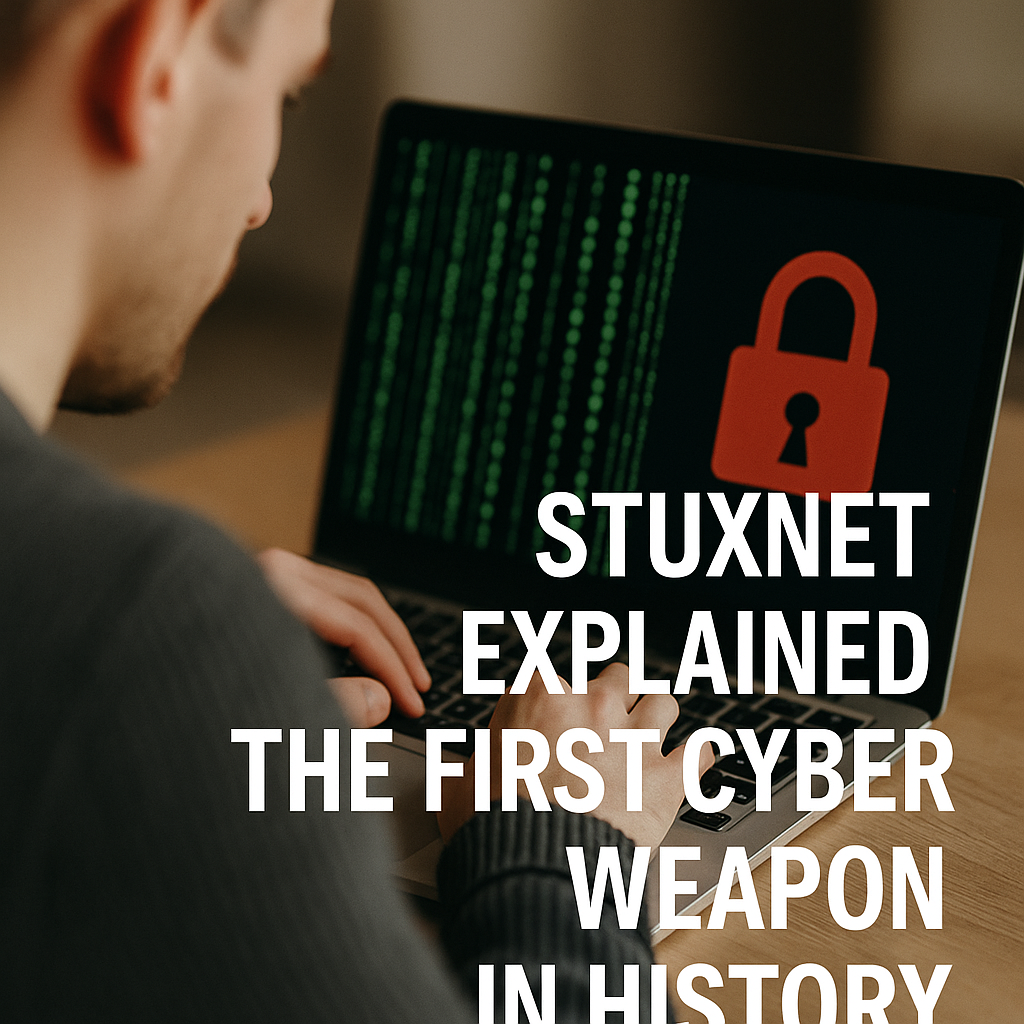
The Stuxnet attack is widely regarded as one of the most significant events in cybersecurity history. Discovered in 2010, Stuxnet was highly sophisticated malware designed to interfere with industrial control systems and cause physical disruption to equipment.
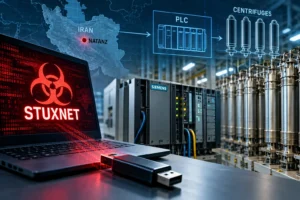
Unlike conventional malware that steals passwords or financial information, Stuxnet targeted operational technology. Its primary target was widely reported to be the uranium enrichment infrastructure at Iran’s Natanz nuclear facility, where the malware manipulated industrial equipment controlled by Siemens programmable logic controllers (PLCs).
The attack demonstrated that malicious software could cross the boundary between digital systems and the physical world. In doing so, Stuxnet changed how governments, cybersecurity professionals, and critical infrastructure operators viewed cyber threats.
What Was the Stuxnet Attack?
Stuxnet was a highly specialized computer worm designed to compromise Windows systems and ultimately manipulate specific industrial control systems. It was notable for its technical sophistication, use of multiple previously unknown vulnerabilities, and ability to alter industrial processes while attempting to conceal those changes from operators.
Rather than indiscriminately damaging every infected computer, Stuxnet searched for a very specific industrial configuration. Systems that did not match its intended target could become infected without experiencing the destructive behavior for which the malware became famous.
Who Created Stuxnet?
The exact authorship of Stuxnet has never been officially established through a universally accepted public attribution. However, the malware’s sophistication, resources, and highly specific target led security researchers and media investigations to associate it with a state-sponsored operation.
Its development would have required extensive knowledge of Windows vulnerabilities, Siemens industrial technology, nuclear enrichment processes, and the physical behavior of centrifuges. That combination made Stuxnet fundamentally different from most criminal malware circulating at the time.
How Did the Stuxnet Attack Work?
The Stuxnet cyberattack used several stages to move from ordinary Windows computers into industrial control environments.
1. Initial Infection Through Re
movable Media
One of Stuxnet’s most important characteristics was its
ability to spread through removable storage devices such as USB drives. This gave the malware a potential route into networks that were isolated from the public internet.
Air-gapped systems are often considered more secure because they have no direct internet connection. Stuxnet demonstrated that physical isolation alone cannot eliminate cyber risk when files, laptops, removable media, or maintenance devices move between environments.
2. Exploitation of Windows Vulnerabilities
After entering a Windows environment, Stuxnet used multiple vulnerabilities to spread and gain additional privileges. Several of these vulnerabilities were zero-days when the malware was discovered, meaning defenders had not previously known about them or had patches available when the attack was originally developed.
The use of multiple advanced exploits significantly increased Stuxnet’s ability to propagate inside targeted environments.
3. Use of Stolen Digital Certificates
Stuxnet also used digitally signed components associated with legitimate companies. Digital signatures can help software appear trustworthy to operating systems and security tools.
This technique made the malware more difficult to detect and demonstrated how attackers could abuse trusted software mechanisms as part of sophisticated cyber op
erations.
4. Detection of the Intended Industrial System
Stuxnet did not immediately sabotage every infected machine. Instead, it searched for Siemens Step7 software and specific PLC configurations associated with its intended industrial target.
This targeting mechanism allowed the
malware to behave more like a precision weapon than a conventional computer virus.
5. PLC Manipulation
Once Stuxnet identified the targeted configuration, it modified PLC instructions controlling industrial equipment. PLCs are specialized computers used to automate machinery and physical processes in factories, utilities, manufacturing facilities, and critical infrastructure.
In the environment targeted by Stuxnet, the malicious instructions reportedly manipulated centrifuge operating speeds. These changes placed abnormal stress on the equipment and could contribute to premature failures.
6. Concealing the Attack
One of the most sophisticated elements of Stuxnet was its ability to conceal malicious activity. While physical processes were being manipulated, operators could receive information that appeared normal.
This combination of sabotage and deception made the attack particularly dangerous because physical damage could occur before defenders fully understood what was happening.
USB Device → Windows Infection → Network Propagation → Siemens Step7 Detection → PLC Manipulation → Physical Disruption
Why Was Stuxnet So Important?
Stuxnet changed cybersecurity because it demonstrated that malware could intentionally manipulate physical infrastructure.
Before Stuxnet, many organizations primarily associated cyberattacks with stolen data, website disruption, fraud, or espionage. Stuxnet showed that cyber operations could also interfere with industrial machinery.
This created major implications for sectors such as:
- Energy and electrical utilities
- Water and wastewater systems
- Manufacturing
- Oil and gas
- Transportation
- Chemical processing
- Nuclear infrastructure
As industrial systems became increasingly connected to corporate networks and remote management platforms, protecting operational technology became an important part of modern cybersecurity strategy.
Stuxnet and the Rise of Cyber Warfare
The Stuxnet attack also became an important case study in discussions about cyber warfare. It showed how cyber operations could potentially achieve strategic objectives without relying exclusively on conventional military methods.
The attack blurred traditional distinctions between cyber espionage, sabotage, intelligence operations, and military activity.
Since Stuxnet, governments and critical infrastructure operators have placed greater emphasis on understanding attacks against industrial control systems and preparing for cyber incidents that could affect physical operations.
What Is the Difference Between IT and OT Security?
Understanding Stuxnet requires recognizing the difference between information technology and operational technology.
Information technology (IT) systems primarily process, store, and transmit information. Examples include email servers, databases, employee computers, and cloud platforms.
Operational technology (OT) systems monitor or control physical processes. Examples include PLCs, industrial controllers, manufacturing equipment, power systems, and building automation systems.
In traditional IT security, confidentiality and data protection are often major priorities. In OT environments, availability, reliability, safety, and physical process integrity can be equally or even more important.
What Cybersecurity Lessons Did Stuxnet Teach?
The Stuxnet attack revealed several cybersecurity lessons that remain relevant to organizations operating critical infrastructure.
Network Segmentation
Critical industrial systems should be appropriately separated from ordinary corporate networks. Network segmentation can reduce the ability of attackers or malware to move freely between IT and OT environments.
Organizations can create security zones, restrict unnecessary communication, and closely control connections between sensitive industrial assets and other networks.
Control of USB Drives and Removable Media
Stuxnet demonstrated why removable media can represent a significant risk to isolated networks.
Organizations operating sensitive environments should establish strict policies for USB drives, external storage devices, engineering laptops, and maintenance equipment that connect to industrial systems.
Patch and Vulnerability Management
Security updates are essential for reducing exposure to known vulnerabilities. However, patching industrial systems can be more complicated than updating ordinary office computers because downtime may interrupt critical operations.
OT organizations therefore need structured vulnerability-management programs that balance cybersecurity risks with operational requirements.
Application Allowlisting
Application allowlisting can prevent unauthorized software from executing on sensitive systems. Rather than attempting to identify every possible malicious program, organizations define which applications are permitted to run.
This approach can be particularly useful in industrial environments where authorized software changes relatively infrequently.
Continuous OT Monitoring
Organizations should monitor both traditional network activity and industrial processes for unusual behavior.
Security monitoring tools can identify suspicious authentication attempts, unexpected network connections, configuration changes, unusual PLC activity, or deviations from established operational patterns.
Incident Response Planning
OT incident response requires coordination between cybersecurity professionals, engineers, operators, management, and safety teams.
An effective response plan should address both the digital compromise and the potential physical consequences of an incident.
Why Air-Gapped Networks Are Not Completely Secure
One of the most important lessons from Stuxnet is that an air gap is not an absolute security boundary.
Even when a sensitive system has no direct internet connection, malware can potentially enter through:
- USB drives
- Engineering workstations
- Vendor laptops
- Maintenance equipment
- Software updates
- Portable storage devices
- Supply-chain compromise
Organizations therefore need multiple layers of security rather than relying entirely on physical network separation.
Could a Stuxnet-Like Attack Happen Today?
The underlying security problem demonstrated by Stuxnet remains relevant. Modern industrial environments increasingly rely on connected devices, remote access, industrial networks, and software-based control systems.
An attacker targeting critical infrastructure could potentially attempt to compromise engineering systems, manipulate industrial processes, disrupt operations, or interfere with safety mechanisms.
However, awareness of OT cybersecurity has increased considerably since Stuxnet. Organizations can now draw on specialized security frameworks, industrial monitoring platforms, improved network segmentation techniques, and dedicated incident-response practices.
How Organizations Can Protect Industrial Control Systems
A strong OT security program typically uses multiple defensive layers rather than relying on a single security product.
Important measures include:
- Maintaining an accurate inventory of OT assets
- Separating IT and OT networks where appropriate
- Restricting remote access to industrial systems
- Applying patches according to operational risk
- Monitoring industrial network traffic
- Controlling removable media
- Using strong authentication and access controls
- Backing up critical configurations
- Testing incident-response procedures
- Training engineers and employees in cybersecurity awareness
Organizations operating critical infrastructure can also consult guidance from the Cybersecurity and Infrastructure Security Agency (CISA) and security frameworks relevant to industrial control environments.
Frequently Asked Questions About Stuxnet
What was Stuxnet?
Stuxnet was sophisticated malware designed to target specific industrial control systems. It became famous for manipulating equipment associated with Iran’s uranium enrichment infrastructure.
When was Stuxnet discovered?
Stuxnet was publicly discovered in 2010, although analysis indicated that development and deployment had begun earlier.
What did Stuxnet target?
The malware was designed to identify specific Siemens industrial control configurations. Its best-known target was associated with centrifuge systems used in uranium enrichment at Iran’s Natanz facility.
Was Stuxnet the first cyber weapon?
Stuxnet is frequently described as the first widely known cyber weapon specifically designed to cause physical disruption through malicious software. Earlier cyber operations existed, but Stuxnet became a landmark example because of its targeted manipulation of industrial machinery.
How did Stuxnet spread?
Stuxnet could spread through several mechanisms, including infected removable media and Windows network vulnerabilities. This allowed it to reach systems that were not directly connected to the internet.
Why is Stuxnet still important?
Stuxnet remains important because it demonstrated that cyberattacks can affect physical infrastructure. Its discovery helped accelerate the development of modern operational technology and industrial cybersecurity practices.
Conclusion: The Lasting Legacy of the Stuxnet Attack
The Stuxnet attack marked a turning point in cybersecurity. It demonstrated that sophisticated malware could infiltrate industrial environments, manipulate physical equipment, conceal its actions, and potentially achieve strategic objectives through software.
Its legacy extends far beyond the systems originally targeted. Stuxnet forced governments and organizations to reconsider the security of industrial control systems and recognize that critical infrastructure can be vulnerable to highly targeted cyber operations.
For cybersecurity professionals, Stuxnet remains an essential case study in malware analysis, OT security, industrial control system protection, network segmentation, and cyber-physical risk.
Organizations seeking additional defensive guidance can consult resources from CISA, MITRE ATT&CK, and OWASP.